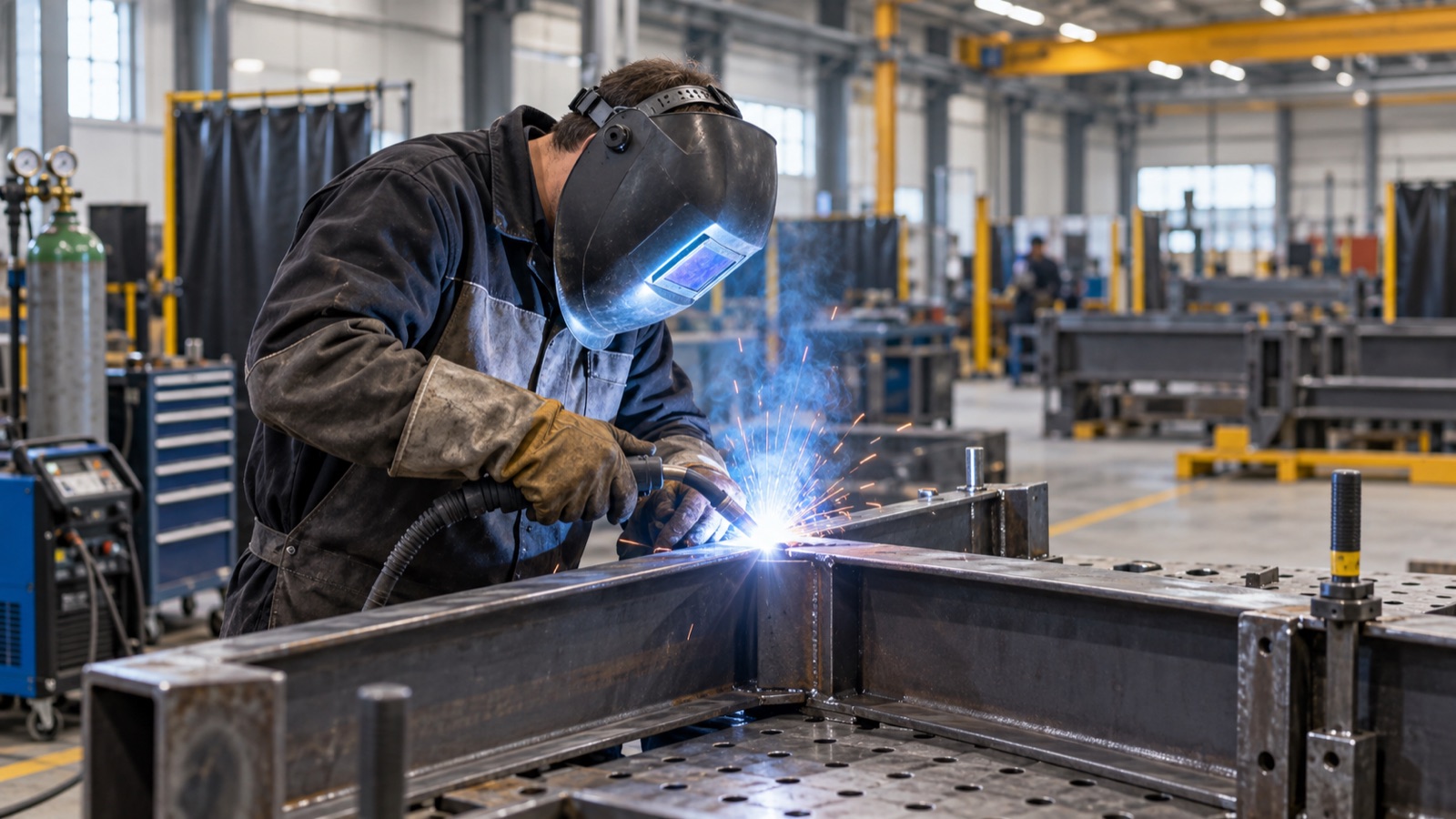
Direct answer: the best welding jobs in Europe for foreign workers are the roles where your process, certificate, test result and employer offer match a real national work-permit route. Start with MIG/MAG production welding, TIG stainless welding, pipe welding, structural steel welding, shipyard welding, fabrication welding, maintenance repair welding and welding chargehand or supervisor roles. The strongest candidates can prove exactly what they weld, in which position, with which material and under which standard. The riskiest offers sell "Europe welding visa sponsorship" without naming the employer, country, test, contract or authority.
Table of contents
- How to read this list
- Best welding jobs for foreign workers
- Best countries to compare first
- Certificates, tests and documents
- How to avoid weak welding offers
- FAQs
How to read this list
This guide was reviewed on 20 September 2026 against current search results and official sources. It is written for Dubai-based and UAE-based foreign workers comparing welding jobs in Europe. It is general information, not legal advice, not a job offer and not a promise of approval, salary, accommodation, travel date, residence or employment.
The current search results for "best welding jobs in Europe for foreign workers" are mostly commercial visa-sponsorship pages, recruitment landing pages and trade guides. The leading pages usually discuss MIG, TIG, stick, pipe welding, shipyards, Germany, the Netherlands, Poland, Czechia and Nordic countries. They often include salary ranges, certificate advice, employer tests, scam warnings and FAQs. The gap is official sourcing. Many pages say welders are "in demand" or that sponsorship is easy, but they do not show the government route that decides whether a non-EU worker can legally work.
That distinction matters. The European Commission explains that EU and national rules overlap, but residence-permit applications must be made to the authorities of the EU country involved, and there is no EU institution that issues residence permits for individual member countries. Your Europe also says a non-EU national's right to work in an EU country depends on nationality, family status and national law. In plain English: there is no universal Europe welding visa.
VisAVis is mentioned here only because its Dubai-to-Europe recruitment work sits close to this decision. A welding offer is useful only when the process, test, employer, pay, documents and permit route all line up. Use this guide alongside blue-collar overseas placement, permanent placement, the broader best European countries for blue-collar jobs and the construction jobs guide.
Best welding jobs for foreign workers
| Rank | Welding role | Best fit | Main risk to check |
|---|---|---|---|
| 1 | MIG/MAG production welder | Manufacturing, automotive, frames, machinery and repetitive steel work | Employer weld test, shift targets and whether the contract is direct or agency supplied |
| 2 | TIG stainless welder | Food, pharma, process piping, stainless fabrication and clean welds | Process-specific test, thin material control and certificate expiry |
| 3 | Pipe welder | Industrial, energy, petrochemical, ship repair and pressure systems | Position, material, NDT record and whether local certification is required |
| 4 | Structural steel welder | Construction, bridges, platforms, workshops and steel frames | Site safety, drawings, working at height and local site cards |
| 5 | Shipyard welder | Shipbuilding, repair yards, offshore suppliers and heavy fabrication | Contract length, accommodation, subcontracting chain and safety rules |
| 6 | Fabrication welder | Workshops making stairs, tanks, trailers, gates, frames and components | Low pay hidden behind "training" and unclear process requirements |
| 7 | Maintenance repair welder | Factories, plants, ports and construction equipment | Broad skill expectations and emergency call-out terms |
| 8 | Welding chargehand or supervisor | Experienced welders who can lead a bay, crew or quality process | Language, reporting duties and whether pay matches responsibility |
1. MIG/MAG production welder
MIG and MAG production welding is often the most realistic starting point for foreign workers because European manufacturers and metal workshops can test it quickly. It appears in automotive suppliers, steel structures, machinery, trailers, agricultural equipment and general fabrication.
This role is strongest when you can show repeated shop-floor experience: process used, material thickness, positions, drawings, jigs, production targets and quality checks. A CV that says "MIG/MAG welder, carbon steel, fillet welds, 135 process, 6 mm to 12 mm plate, automotive frames" is more useful than "welder with five years experience."
The risk is that production roles may be fast, repetitive and agency supplied. Ask whether the employer is the factory or a staffing agency, whether the pay is gross or net, who provides accommodation, what happens if you fail the weld test and whether overtime is guaranteed or only possible.
2. TIG stainless welder
TIG stainless welding can be one of the better welding tracks because it is harder to replace with a general labourer. It can fit food processing, pharmaceutical plants, kitchens, tanks, process pipe, clean fabrication and specialised workshops.
For UAE-based candidates, this is where proof matters. Employers want to know process, material, thickness, position, drawings, purge setup, visual quality and whether your work has passed inspection. Photos can help, but certificates, employer references and test results are stronger.
Do not assume every TIG role pays well. Thin stainless, pipe, pressure work and clean process work are different from light decorative fabrication. Ask what will be tested and what standard or employer procedure will be used.
3. Pipe welder
Pipe welding is usually the most specialised option in this list. It can involve stainless, carbon steel, pressure pipe, plant maintenance, energy, petrochemical, ship repair and shutdown work. It can also require the toughest tests.
A serious pipe-welding application should state material, diameter, wall thickness, position, process, backing, purge, inspection type and whether the work passed radiography, ultrasonic testing or pressure testing. If you have never welded pipe in position, do not present yourself as a pipe welder because the practical test will expose it quickly.
The permit question is separate from the welding question. A strong pipe welder still needs a named employer and the correct national route. If the recruiter promises a fixed approval date before testing or employer documents, treat that as a warning sign.
4. Structural steel welder
Structural welding can sit between construction and manufacturing. The work may involve beams, columns, platforms, stairs, railings, supports and steel frames. It can be workshop-based or site-based.
This role suits welders who can read basic drawings, work around fitters and fabricators, understand tolerances and follow safety procedures. Site work may involve lifting, height, weather, permits to work and coordination with construction crews.
The risk is title blur. Some offers use "structural welder" for a true welding position. Others use it for a helper who grinds, carries steel and occasionally tacks. The difference matters for pay, dignity, safety and immigration fit.
5. Shipyard welder
Shipyards appear often in welding search results because Europe has shipbuilding, repair, offshore, marine equipment and yacht sectors. The work can be heavy, noisy and project based. It can also be a good fit for welders with Gulf shipyard, offshore, port or industrial maintenance experience.
Ask whether the role is new build, repair, shutdown, hull work, pipework, stainless, aluminium or heavy plate. Ask which company signs the contract and whether you are working for the yard, a subcontractor or an agency. A long subcontracting chain can make pay, accommodation and responsibility harder to understand.
Shipyard work can be legitimate, but the offer should explain safety induction, PPE, working hours, accommodation and who pays travel or local transport.
6. Fabrication welder
Fabrication welding is broad. It can include gates, stairs, tanks, trailers, small structures, supports, furniture, industrial frames or custom metalwork. This can be a useful route for candidates who have real workshop experience but do not hold advanced pipe or coded-welding credentials.
The best fabrication candidates can show versatility without exaggeration. List the tools, materials, drawings, machines and process you actually used. Include measuring, cutting, grinding, tack welding, fitting and finishing if those were part of the job.
The risk is low pay dressed as "training". Training is not bad, but it should be honest. Ask whether you will be paid as a trainee, helper or welder, and whether any test or certificate is required before your pay grade changes.
7. Maintenance repair welder
Maintenance repair welders work around factories, quarries, ports, farms, construction equipment and industrial plants. The work may involve broken brackets, worn parts, machinery guards, containers, buckets, frames and emergency repairs.
This role fits candidates who can troubleshoot, work safely outside perfect bench conditions and explain what they repaired. It can be stronger than a production role when the employer needs a practical all-rounder.
The risk is breadth. Maintenance teams may expect welding, fitting, grinding, gas cutting, basic mechanics, shift cover and call-outs. Ask for the actual duties. A repair welder role should not quietly become general plant labour.
8. Welding chargehand or supervisor
Welding chargehand, bay leader, foreman and supervisor roles are best for experienced welders who can guide others, plan work, review quality and communicate with production or site managers. These roles can be stronger long term, but they are rarely the easiest entry route.
Useful proof includes crew size, processes supervised, quality records, productivity targets, safety talks, WPS familiarity, repair rates and inspection coordination. Language matters more here because supervisors handle instructions, incidents and paperwork.
The title should match the contract. If the pay and authority look like a basic welding job, ask why the role is called supervisor.
Best countries to compare first
Country choice should follow the welding process and employer, not the social-media salary screenshot. EURES reported in June 2026 that shortages are still uneven across Europe and specifically mentioned countries where employers reported difficulties filling roles including welders. Its labour-market material also shows that shortages and surpluses vary by country and occupation, so a shortage in one place does not prove eligibility everywhere.
| Country | Best welding fit | Official check to make before committing |
|---|---|---|
| Germany | Qualified welders, experienced non-regulated workers, supervisors and industrial trades | Whether the role is qualified, salary meets the route and Federal Employment Agency approval is needed |
| Czechia | MIG/MAG, TIG, fabrication and manufacturing-linked welding roles | Employee-card vacancy, work relation, accommodation proof, qualification request and embassy process |
| Poland | Fabrication, construction steel, manufacturing and site support | MOS filing requirement, employer attachment, fee, pay floor and temporary residence/work conditions |
| Croatia | Shipyard, construction steel and project-linked welding roles | Residence and work permit, Croatian Employment Service opinion or exemption, named employer and job |
| Netherlands | Shipbuilding, offshore suppliers, industrial workshops and skilled fabrication | Employer sponsorship duties, paid-employment route, work permit or single-permit requirements |
| Norway | Skilled industrial, shipyard and energy-sector welding | UDI skilled-worker criteria, vocational training, job offer and employer confirmation requirements |
Germany can be attractive for qualified welders, but it is not a simple "show up and weld" market. Make it in Germany says the professionally experienced worker route is for non-regulated professions and requires a recognised foreign qualification from the country of training, at least two years of relevant qualified experience in the last five years, a concrete job offer and Federal Employment Agency approval. The official page lists a 2026 gross annual salary threshold of EUR 45,630, or collective-agreement pay. For applicants over 45, it lists EUR 55,770 or adequate pension provision.
Czechia is practical for manufacturing and shop-floor welding because the employee card can allow third-country nationals to stay and work for longer than three months. The official Czech portal says the card can be issued for all kinds of employment regardless of required education and qualification, but the application still needs documents such as a travel document, photograph, proof of accommodation, proof of work relation and vacancy identification where relevant. If the employer or law requires qualification proof, be ready to provide it.
Poland is visible in industrial and fabrication recruitment, but the process should be checked through MOS and the employer. Poland's Office for Foreigners says that since 27 April 2026, many residence applications, including temporary residence, are submitted electronically through the MOS portal. The same guidance says access to MOS is free, but applicants can still incur stamp duty and a residence-card fee. If someone asks for a large "portal fee," ask what official fee they mean.
Croatia can fit shipyard, construction steel and project work where the employer is real. Croatia's official gov.hr guidance says third-country nationals may work only in the jobs for which they have been granted a residence and work permit or work registration certificate, and only with the employers named. Where a labour-market test is required, the employer requests it from the Croatian Employment Service before applying for the permit.
The Netherlands can be strong for shipbuilding, offshore suppliers and industrial workshops, but sponsorship is not casual. IND guidance says an employer that employs a foreign national becomes that worker's sponsor and must meet sponsor obligations. Paid-employment routes may involve a work permit or a single permit depending on the case. For welders, the employer's compliance matters as much as the wage.
Norway is not in the EU, but it appears often in welding SERPs because of shipyards, offshore supply chains and industrial pay. UDI guidance says skilled workers generally need higher education or vocational training and normally need a job offer. Norway can be worth comparing for experienced welders, but it should not be treated as an easy fallback for candidates with no certificate, no test record and no named employer.
Certificates, tests and documents
Welding is more certificate-driven than many blue-collar jobs. ISO lists ISO 9606-1:2012 as the international standard for qualification testing of welders for fusion welding of steels, and notes that the standard was reviewed and confirmed in 2023. That makes ISO 9606 useful language for a European employer conversation, especially when paired with the process, material and position.
But ISO 9606 is not a visa. It is also not proof that every employer or country will accept your existing certificate without testing. Many serious employers will test you on the exact process they need: MIG/MAG, TIG, stick, flux-cored, pipe, plate, stainless, carbon steel, vertical, overhead or other positions. Ask for the test details before you travel.
Prepare a welding-specific file:
- Passport with enough validity for the intended process.
- CV listing exact welding processes, materials, thicknesses and positions.
- Experience letters naming employer, dates, job title, duties and project type.
- Welding certificates with process, material, position, expiry and issuing body.
- Photos of work only when they are allowed by your employer and do not reveal confidential sites.
- Test records, NDT reports or quality documents if you can lawfully share them.
- Safety cards, hot-work permits, confined-space training or site induction records if real.
- Education or vocational training documents where the route asks for them.
- Police clearance or criminal-record document where required.
- Translations, legalisation or attestation where the destination authority requires them.
For UAE-based candidates, document handling can be the quiet blocker. UAE MoFA's attestation service says the appropriate route can be digital or courier-based depending on document type and issuing authority, and that documents requiring different attestation methods may need separate applications. Check this before a recruiter gives you an urgent deadline.
How to avoid weak welding offers
Welding is attractive to recruiters because it sounds specific, skilled and in demand. That also makes it easy to market badly. A real vacancy still needs a real employer, a real worksite, a contract, a test, a lawful pay arrangement and an official route.
The UAE Government's labour and visa fraud guidance tells jobseekers to verify company existence and be careful with false job offers. It also notes that under UAE Labour Law, employers are responsible for recruitment expenses. Even when the destination job is outside the UAE, the principle is useful: be suspicious of any offer that asks for money first and evidence later.
Use this checklist before paying money, resigning, sending originals or travelling:
- What is the legal employer name?
- Which country, city and worksite is the job in?
- Which welding process, material and position will be tested?
- Is the contract with the plant, shipyard, workshop, subcontractor or agency?
- Is the wage gross or net?
- What deductions apply for accommodation, food, transport, tools, PPE or agency services?
- Which authority issues the work or residence permission?
- Who files each step: employer, candidate, agency or lawyer?
- What official government, consular, medical, translation, attestation or courier fee is payable?
- What is refundable if the employer withdraws or the authority refuses?
- Can you verify the employer through a company register, official email or public careers page?
- Does anyone promise guaranteed approval, guaranteed salary, guaranteed arrival or a fixed processing date?
A serious recruiter can answer these questions. A serious employer can explain the weld test, process, pay, shift, accommodation, PPE and permit route. A serious candidate should also be honest: do not invent ISO certificates, NDT history, pipe experience, supervisor work or safety cards. Welding tests are practical, and false claims fail quickly.
Which welding job should you choose?
If you already have a current process-specific certificate, start with the matching process. MIG/MAG production welders should compare manufacturing and fabrication employers. TIG stainless welders should compare food, pharma, process and clean-fabrication employers. Pipe welders should compare industrial, shipyard and energy-sector roles. Structural welders should compare workshops and construction steel employers. Supervisors should compare roles only where language and references support the title.
If you have welding experience but no transferable certificate, do not assume you are blocked. You may still be testable, especially for fabrication or production roles, but you should expect an employer weld test and possibly retraining. If you have only helper experience, compare entry-level fabrication and construction support carefully and do not pay for a "coded welder" promise before you can pass the test.
The best welding job in Europe is not the one with the biggest monthly number in a poster. It is the one where your actual process, certificate, test readiness, contract, employer, safety conditions, documents and permit route can all be checked before you move.
Informational disclaimer: this article is general information for UAE-based candidates and employers comparing European welding work routes. It is not legal, immigration, tax, recruitment or employment advice. Rules, fees, forms, salary thresholds, quotas, documents and processing practices can change, and individual outcomes depend on nationality, qualifications, employer, country and responsible authority. Always confirm your case with the official authority or an appropriately licensed professional before acting.
Official sources checked
- European Commission: Who does what in EU immigration
- Your Europe: Work permits
- EURES: What the latest data reveals about labour market imbalances across Europe
- EURES: Labour shortages and surpluses in Europe
- ISO: ISO 9606-1:2012 qualification testing of welders
- Germany: Visa for professionally experienced workers
- Czechia: Employee Card
- Poland Office for Foreigners: Basic information about the MOS system
- Croatia: Work of foreign nationals
- Netherlands IND: Employing a foreign national
- Norway UDI: Skilled workers
- UAE MoFA: Attestation of official documents and certificates
- UAE Government: Tips to stay safe from labour and visa fraud
FAQs
What are the best welding jobs in Europe for foreign workers?
The best first shortlist is MIG/MAG production welder, TIG stainless welder, pipe welder, structural steel welder, shipyard welder, fabrication welder, maintenance repair welder and welding chargehand or supervisor. The right choice depends on your process, certificate, employer test, documents, language, country and permit route.
Can foreign welders get visa sponsorship in Europe?
Yes, some foreign welders can be sponsored by European employers, but there is no single Europe-wide welding visa. Most cases depend on a named employer, contract, salary, accommodation, national work or residence rules and the responsible authority's decision.
Do I need ISO 9606 to get a welding job in Europe?
Not always, but it can help. ISO 9606-1 is a recognised qualification-testing standard for fusion welding of steels. Employers may still require a fresh test, local certificate, translation, proof of experience or route-specific documents.
Which country is best for welders in Europe?
There is no single best country. Germany can be strong for qualified or experienced welders, Czechia and Poland can be practical for manufacturing and fabrication, Croatia can fit shipyard and project work, the Netherlands can fit shipbuilding and industrial employers, and Norway can fit skilled industrial welders with strong documents.
What should a Dubai-based welder check before paying an agency?
Check the legal employer name, country, worksite, welding process, test requirements, contract party, gross pay, deductions, accommodation, official permit route, government fees, refund terms and whether the employer can be verified independently. Do not rely on a poster, voice note or guaranteed-approval claim.