The best factory jobs in Europe with visa sponsorship to shortlist are CNC machinist, industrial maintenance technician, process machine operator, quality inspector, assembly operator, food-production worker and packaging operator. The best match depends on what you can demonstrate and whether a named employer can recruit you through the destination country's rules. These are roles to investigate, not seven confirmed vacancies or a promise of sponsorship.
For someone working in Dubai or elsewhere in the UAE, the useful question is specific: does this factory need my skills, and can it explain the lawful route for my nationality and circumstances? An attractive production-line photograph or a monthly salary screenshot cannot answer that.
Reviewed 16 October 2026. This guide provides general information, not legal or immigration advice, a job offer or a guarantee of employment or permission to work. Confirm individual requirements with the responsible authority or an appropriately licensed professional before paying, resigning or travelling.
Contents
- Compare the seven roles
- What sponsorship means
- Three country-route checks
- Compare pay and living costs
- Check the employer and application
- Questions applicants ask
Compare the seven factory roles
This order is an editorial starting point based on how clearly candidates can demonstrate specialist skills, followed by broader production roles. It is not a salary ranking, a measure of vacancy numbers or an assessment of approval chances. An experienced assembly worker may be a better match for a particular plant than a technician whose equipment experience is unrelated.
| Role | Useful evidence | Question before accepting |
|---|---|---|
| CNC machinist | Machine controls, materials, drawings and measurement skills | Operator, setter or programmer? |
| Maintenance technician | Fault diagnosis, maintenance records and training | Which machinery and responsibilities? |
| Process machine operator | Production settings, changeovers and batch records | What training and shift pattern? |
| Quality inspector | Gauges, inspection records and defect reporting | Visual checks or technical metrology? |
| Assembly operator | Components, tools and production experience | What pace and task rotation? |
| Food-production worker | Hygiene routines and relevant product experience | What temperature and physical conditions? |
| Packaging operator | Line checks, label control and changeovers | Machine operation or manual packing? |
1. CNC machinist: for candidates with demonstrable machining skills
Start here if you have worked with computer-controlled lathes, mills or machining centres. Your application should distinguish loading parts from setting tools, adjusting offsets and writing or editing programs. These are different levels of responsibility, even when advertisements call all of them “CNC operator”.
Describe the controls you have used, materials machined, drawing-reading skills and measuring equipment. A concise example of how you detected an out-of-tolerance part is more informative than a long list of machinery brands. Share examples only where your previous employer permits it; do not send confidential customer drawings.
Ask how the employer assesses practical ability. A remote technical interview can clarify whether the job matches your experience before either side spends money. Confirm who handles setup, how training works and whether the role includes night shifts. Strong machining experience helps explain your fit, but it does not replace the immigration requirements.
2. Industrial maintenance technician: for troubleshooting experience
Maintenance may suit applicants whose experience includes conveyors, pumps, motors, production equipment or preventive maintenance. Make your mechanical, electrical and automation responsibilities clear. “Maintenance technician” can describe very different work from one plant to another.
Prepare examples of fault diagnosis, planned servicing and safe escalation when a repair was beyond your authority. List genuine qualifications and training separately from tasks learned on the job. Avoid claiming electrical authorisation or specialist certification that you do not hold.
Before accepting, ask about the equipment, on-call expectations, team size and training. Find out whether the vacancy involves independent intervention or supervised assistance. The employer should explain any local qualification or authorisation checks relevant to those duties. A technical title alone is insufficient evidence that a skilled-worker route applies.
3. Process machine operator: for repeatable production knowledge
This option is worth investigating if you monitor production settings, record batches, perform changeovers or respond to basic machine alarms. Examples could include plastics, paper products or other manufactured goods; the important match is the actual process and equipment.
A useful CV explains the product, the part of the line you controlled and the checks you performed. Distinguish routine adjustments from repairs handled by maintenance staff. If you improved output or reduced waste, provide a figure only when you can substantiate it.
Ask how operators are trained on the new line, which instructions must be understood and how faults are reported. Clarify whether you will run one station or several machines. Also ask what happens to scheduled hours during maintenance shutdowns or reduced production. That detail can matter more to your budget than an advertised overtime opportunity.
4. Quality inspector: for careful measurement and documentation
Inspection roles can suit candidates with experience checking dimensions, appearance, labels or production records. Some positions involve basic visual sorting; others require measuring instruments, technical drawings and formal inspection reports. Apply to the level you can actually perform.
Evidence might include familiarity with callipers, micrometers, gauges, traceability records or defect categories. Explain how you document a problem and escalate a non-conforming batch. Do not present familiarity with one company's procedures as an internationally recognised certification.
Ask what inspection decisions you are authorised to make, how records are kept and what language the instructions use. Confirm whether you work for the manufacturer or a separate inspection contractor. The legal employer, plant location and reporting line should be clear before you agree to relocate.
5. Assembly operator: for consistent hands-on work
Assembly can be a suitable direction for workers who have used hand tools, fixtures, torque tools or component-checking routines. Useful experience includes identifying parts, following work instructions and keeping defects separate from accepted production.
Describe the product and your station rather than writing only “factory worker”. Explain whether you performed repetitive assembly, functional tests or several tasks on rotation. Employers can then assess the connection between your previous job and their line.
Questions about working conditions should be concrete. How long do you remain at one station? Is work seated, standing or mixed? What loads are handled, and what assistance is available? Who explains safety instructions? A position described as entry-level may still require careful communication and a viable national employment route.
6. Food-production worker: for product and hygiene experience
Food production covers different environments: bakery lines, beverage bottling, chilled preparation and other processing operations. Your choice should account for the product, temperature, cleaning duties and physical demands, not simply the description “food factory”.
Explain relevant experience with hygiene routines, batch identification, cleaning schedules and contamination prevention. List training accurately. Ask the employer which training it provides and which evidence it expects before hiring; do not assume a certificate used in the UAE automatically satisfies every destination requirement.
Find out whether the work involves meat handling, cold areas, strong smells or repeated lifting. Request details about protective clothing, changing facilities, breaks and transport for early or late shifts. These questions help you judge the offer without pretending that every food plant offers the same conditions or sponsorship arrangements.
7. Packaging operator: for line checks and changeovers
Packaging roles range from placing finished goods in cartons to operating automated filling, sealing and labelling equipment. A candidate with line-setting or label-verification experience should make that distinction visible in the application.
Ask whether you will operate equipment, check date or batch codes, clear routine stoppages or only pack manually. Confirm the product, shift schedule and training. A role advertised as packaging may also include dispatch work; understand how much time is spent on each duty.
If the actual job is order picking, storage or fulfilment, compare it with our warehouse jobs guide. Manufacturing transforms or assembles products, while warehouse work centres on storing and moving them. That distinction helps you target the right experience and ask better interview questions.
What does factory visa sponsorship actually mean?
In recruitment advertising, “sponsorship” often means that an employer is willing to support an immigration application. Ask what that support includes: a contract, an employer filing, supporting documents, fees or relocation assistance. Do not assume all five are included.
Your Europe explains work-permit rights by nationality and status; non-EU applicants must check the destination's rules. Living in the UAE does not itself establish a right to work in an EU country. Equally, applicants who already have relevant work rights should explain that status accurately instead of assuming they need the same process as everyone else.
A useful response from an employer names the country, legal employing entity, role, proposed route and responsibilities of each party. “We arrange Europe papers” leaves too much unresolved. Ask for the official route page and compare it with your circumstances.
Three country-route checks before you shortlist an offer
These examples illustrate different systems, not a ranking of the easiest countries. They are starting checks rather than complete eligibility assessments.
Germany: is this genuinely qualified employment?
The official work visa for qualified professionals guidance requires a recognised or comparable qualification and a specific qualified job offer. Auxiliary tasks are insufficient for this route. Federal Employment Agency approval is generally required, and additional salary or pension conditions apply to certain first-time workers over 45.
A qualified machining or maintenance offer therefore needs a different assessment from basic packing. Check the full criteria and any other proposed route with the authority; this example does not mean every factory role is eligible or that all applicants use this visa.
Czechia: can the exact job support the application?
Czechia's Employee Card guidance covers employment at different qualification levels. A vacancy identification number is normally part of the application, with exceptions such as free labour-market access or an issued work permit. Agency employment can require additional documentation.
For UAE-based applicants, check the diplomatic mission's jurisdiction and appointment or quota rules before planning around an application in the UAE. Residence there alone is not enough to assume the mission can accept your case. Ask the employer to identify the vacancy and explain its part in the process.
Netherlands: can the employer meet the permit conditions?
The Dutch single permit, or GVVA, combines residence and work permission for the applicable paid-employment route. IND lists conditions including prior recruitment efforts in the Netherlands and EU/EEA, vacancy registration with UWV, appropriate pay and housing arrangements.
An English-language production advertisement is not proof that these conditions can be met. Ask whether the employer accepts applicants needing permission and which route it proposes. Other statuses and routes can differ; have the employer explain the basis relevant to you.
Compare pay and living costs before comparing countries
Build a budget from the written offer. Record contractual gross base pay, guaranteed hours, expected deductions and living costs separately. Ask for an explanation of estimated take-home pay and the assumptions behind it. Do not treat overtime, attendance bonuses or the best-paid shift as guaranteed income.
Compare housing address, number of occupants, rent, deposit, utilities and transport. Ask what happens to accommodation if the assignment ends. Check whether the factory is reachable when your shift starts, especially if shared transport is part of the package.
For relocation costs, request an itemised list distinguishing government charges from recruitment, translation, travel and housing costs. Confirm who receives each payment, what evidence you get and the refund conditions. Check current official charges for the exact route when preparing the application; a bundled “Europe visa price” is not an official fee schedule.
Check the employer and build a targeted application
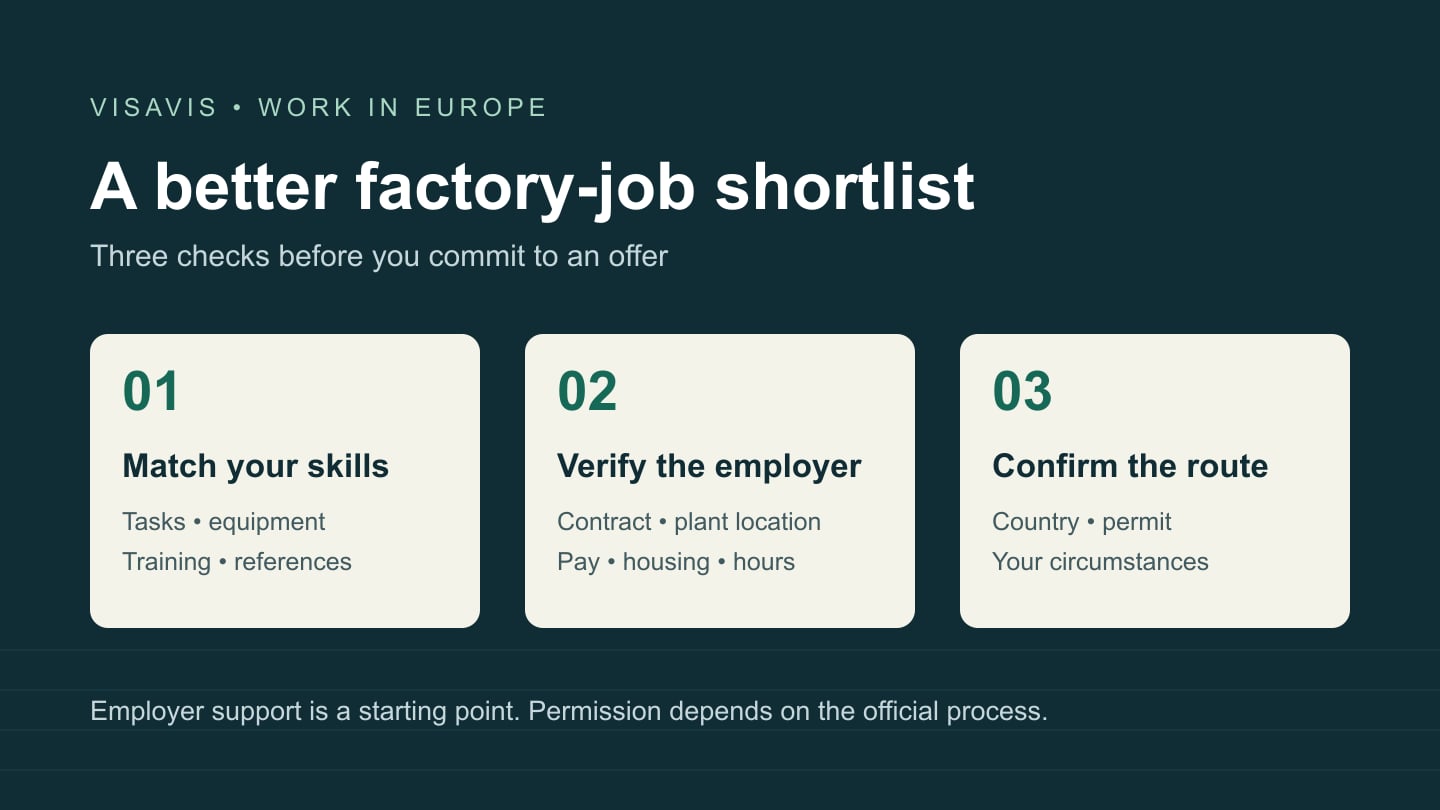
Verify the employer through its public contact details and appropriate company register. Where an agency is involved, establish which entity signs the employment contract, pays wages and hosts you at the factory. A famous manufacturer's name in an advertisement does not establish that you will be employed by it.
Before committing, obtain clear answers to these questions:
- What is the legal employer name, plant address and exact job description?
- Does the employer accept someone with my nationality, residence status and qualifications?
- Which permit route is proposed, and who handles each step?
- What pay, hours, deductions and accommodation terms are contractual?
- What happens if permission is refused, the start date moves or the assignment ends?
- Can I confirm the offer through an independently found company contact?
Prepare a role-specific CV, accurate employment dates, references and genuine training records. Ask which documents require translation or legalisation before spending money; our document legalisation field guide helps organise that discussion.
VisAVis's overseas placement and permanent placement pages provide context for its recruitment services. Apply the same employer, contract and permit checks to any intermediary, including VisAVis. No intermediary's involvement removes the need for an authority's decision.
Questions applicants ask
Which factory job should I apply for first?
Choose the role whose actual duties you can demonstrate. Start with CNC or maintenance if you have relevant technical evidence; otherwise assess process operation, inspection, assembly, food production or packaging against your experience and working-condition preferences. Then check the specific offer's immigration fit.
Can I apply without a degree?
Job requirements and immigration requirements are separate. Some factory employers assess practical experience, but that does not establish permit eligibility. Germany's qualified-professional example and Czechia's Employee Card illustrate why you must check the exact national route rather than rely on a “no degree required” advertisement.
Does sponsorship mean the employer pays everything?
Do not assume it does. Request written responsibilities for each charge and service, and verify whether any proposed charge to you is lawful for the arrangement. Treat unclear payment demands as unresolved before you proceed.
Is this a list of factories hiring now?
No. It is a role-comparison and offer-screening guide. Confirm current vacancies directly with the employer, and never treat a job category, country example or recruitment page as a guaranteed opening.